 Login
Login
 Register
 Blog
Blog


Evaluate likes alongside saves, shares, profile actions, follower fit, and content format. Use the Instagram Resources Hub.
Like Exchange: How Community Likes Work
A like exchange is the post-level subset of an engagement exchange. Members complete eligible like tasks, earn credits, and use credits to expose their own public content to other participants.
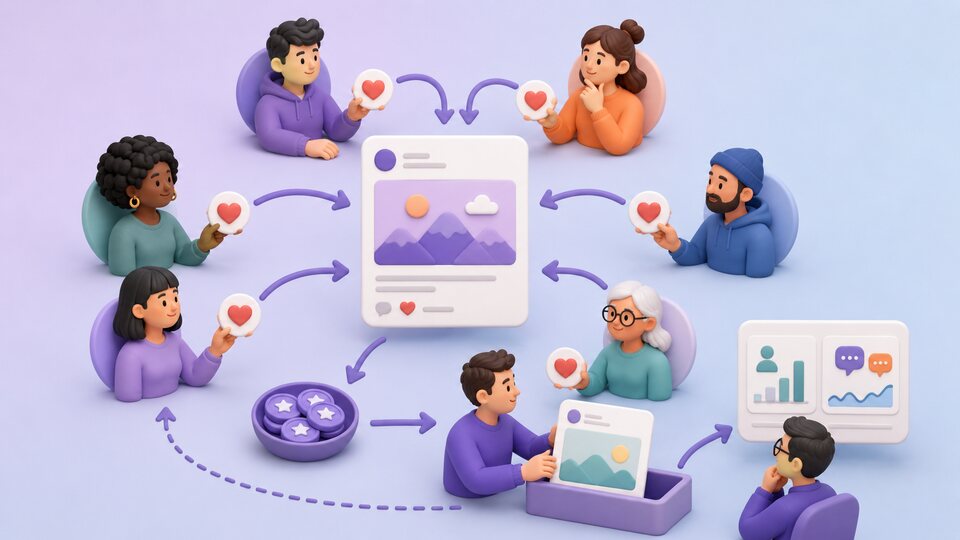
The credit-based like exchange cycle
- A member chooses an available like task and visits eligible public content.
- The member completes and confirms the interaction under current verification rules.
- The account receives the applicable credits.
- The member uses credits to create or support an eligible like campaign.
- Other participating members encounter that public content through the exchange.
No social-network password is required for a Like4Like campaign. The creator provides an eligible public URL. Task availability, pacing, and verification differ by supported network.
What a like can—and cannot—show
| A like can confirm | A like cannot prove |
|---|---|
| A visible account performed a like action at that moment | How long the person watched or read |
| The post received a lightweight public response | That the person belongs to the intended audience |
| The public total may look more active | Future recommendation, sales, or loyal interest |
| A controlled campaign delivered observable actions | That every action will remain permanently |
The same heart icon has different context by platform
TikTok
Likes sit beside watch time, completion, replays, shares, and viewer response. Use the TikTok Resources Hub.
YouTube
A like is one video response; viewing behavior and channel outcomes provide different evidence. See YouTube likes.
Facebook and other networks
Eligibility and the role of public reactions vary with content type and current platform conditions.
Design a like test that teaches you something
- Prepare the content and record its normal baseline.
- Choose one post and one limited campaign amount.
- Use controlled pacing instead of an unexplained burst.
- Observe likes separately from views, profile actions, comments, and conversions.
- Compare retention and later content performance before repeating the test.
More likes are not a substitute for clearer content. If additional visibility produces no relevant downstream behavior, improve the post or audience match before scaling.
Why like totals may later decrease
A participant may reverse an action, an account may become unavailable, or a network may filter activity or refresh the public counter. The lower number shows that the count changed; it does not identify the cause by itself.
Use the platform-specific diagnostic for Instagram like drops, and review current warnings presented when creating campaigns.
Common questions
Is like exchange the same as buying likes?
No. Community exchange uses participation and credits; paid package pages provide a separate order flow for users who do not want to earn credits first.
Are exchanged likes permanent?
They cannot be guaranteed as permanent. Users can reverse actions and platforms can change visible totals.
Can like exchange make a post viral?
No. It can provide a controlled visibility input, while the network controls recommendation and wider distribution.